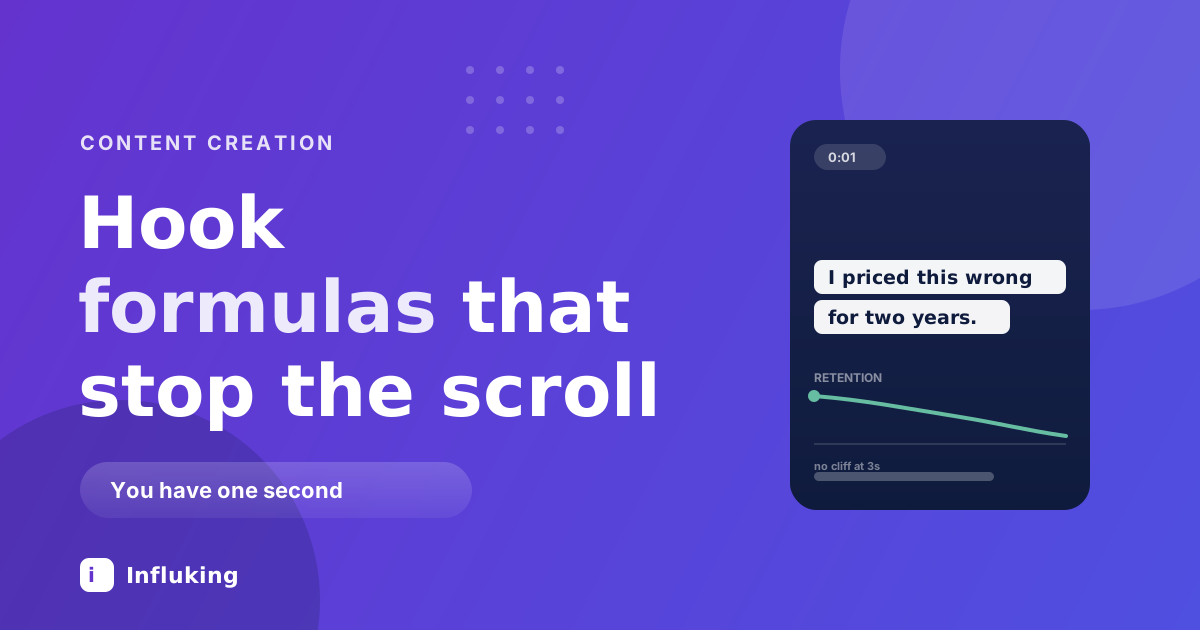
You can spend six hours on a Reel and lose it in the first second. Not because the content was bad, but because the opening gave nobody a reason to wait. Hooks are the highest-leverage sentence in short-form video, and they are one of the few parts of this job that can be reduced to formulas.
What follows is a working library. Steal the structures, fill them with your own specifics, and write ten before you pick one.
A hook has three layers
Most creators write one and wonder why it underperforms. There are three, and they fire at the same time.
The visual hook is what appears on screen. Motion, a face mid-sentence, the finished result, something unexpected. This is what stops the thumb before anyone has read or heard a word.
The text hook is the line on screen, which is doing the work for everyone watching muted. It should say the same thing as the spoken hook, not something different.
The verbal hook is the first thing out of your mouth. It rewards the person who unmuted.
All three should point at the same promise. When the text says one thing and the voice says another, the viewer spends their attention reconciling them instead of staying.
Four rules that make any formula work
- Be specific. "I made a mistake with pricing" is nothing. "I undercharged by 40,000 rupees on one deal" is a hook. Numbers, names, amounts, timeframes.
- Create a gap. The viewer needs to feel they are missing something they want to know. That gap is the only reason anyone stays for second two.
- Cut everything before it. No greeting, no "so basically", no walking into frame. Start on the second sentence you filmed.
- Pay it off fast. A hook that promises something and takes 25 seconds to deliver trains people not to trust your openings.
Curiosity formulas
- The open loop. "This one change took my Reels from 800 views to 40,000." State the outcome, withhold the method.
- The mistake. "I wasted two years doing [common thing]." People stay to check whether they are making it too.
- Nobody tells you. "Nobody tells you this about [topic]." Works because it promises insider information, and dies if the payoff is common knowledge.
- The countdown. "Three things I would do differently if I started [thing] today." Numbers set an expectation of length, which makes staying feel finite.
- Before you. "Before you buy a ring light, watch this." Intercepts someone mid-decision, which is the most valuable moment to catch them.
- The unfinished comparison. "One of these cost ₹200 and one cost ₹2,000." The gap is the question of which is which.
Value formulas
- How to X without Y. "How to grow on Instagram without showing your face." The "without" names the objection your audience already has.
- X in Y time. "Fix your lighting in 60 seconds." Puts a cheap price on their attention.
- The swap. "Stop doing [common thing]. Do this instead." Clear, actionable, and implies they are currently getting it wrong.
- The checklist. "Five things to check before you post a Reel." Highly saveable, which matters because saves push distribution.
- The shortcut. "The fastest way to [outcome] if you have no [resource]." Speaks to the constraint your audience actually has.
Contrarian formulas
- Unpopular opinion. "Unpopular opinion: hashtags are a waste of time." Comments are reach, and disagreement generates comments.
- Stop doing this. "Stop buying followers." Direct instruction with an implied consequence.
- Everyone is wrong. "Everyone tells you to post at 11am. That advice is ten years old." Only use it when you can actually back it up.
- The confession. "I don't use [popular tool] and my reach went up." Admitting something against the grain reads as honest.
Contrarian hooks are the fastest to work and the fastest to damage you if the content underneath is thin. Only pick a fight you can finish.
Identity formulas
- If you are X. "If you have oily skin, do not buy this." Filters instantly, which is good: the wrong viewers leaving is not a loss.
- POV. "POV: you spent an hour editing and it got 300 views." Recognition makes people send it to someone who has lived it, and sends are the strongest signal you can earn.
- The callout. "Freelancers, this one is for you." Simple, and it works because most content addresses nobody in particular.
Story and proof formulas
- Start in the middle. "So the brand replied saying my rate was too high." Drops the viewer into a moment already in progress, with no setup.
- Result first. Show the finished thing, then explain how. The strongest structure for anything with a visible outcome.
- Before and after. Two states side by side in the opening frame. Almost no words required.
- Receipts. "This post made ₹18,000. Here is exactly how." Proof plus method, which is the most reliably saved combination in creator content.
Write ten, use one
The habit that separates people who are good at this: never film with the first hook you thought of. Write ten variations for the same idea, using different formulas from the list above, then pick the one that would stop you.
It takes five minutes and it is the highest return five minutes in your process. Most first attempts are descriptions of the content rather than hooks. "Today I am showing you my skincare routine" describes. "The three products I stopped using after my skin got worse" hooks.
Rules for the text hook on screen
- Six to eight words, readable at a glance while scrolling.
- On screen from frame one, not fading in.
- In the middle of the frame, clear of the interface at the top and bottom.
- Large and high contrast, since it will be read on a phone in daylight.
- Keep it up for two to three seconds, long enough to read twice.
The placement and safe-area details are in our Reel editing guide.
Testing which hooks work for you
The retention graph is the scoreboard. Open a Reel's insights and look at the first three seconds.
- A cliff in the first three seconds means the hook failed. The content underneath may be excellent, and nobody found out.
- A gentle slope means the hook worked and the pacing is losing people later.
- A rise at the end means rewatches, which is the strongest thing you can see.
Track which formula you used on each post in a simple sheet. After twenty Reels you will see that two or three formulas consistently outperform for your audience, and that is your default set. The wider framework for reading these numbers is in our post on making Reels that travel.
What kills a hook
- Vagueness. "Let me tell you something interesting." About what?
- Clickbait that does not pay off. One dishonest hook buys you a view and costs you a follower.
- Slow build. Context before the hook is context nobody hears.
- Text and voice saying different things. Split attention, halved effect.
- Greeting first. "Hey guys, welcome back" is the most expensive four words in short-form.
- A hook that only makes sense to existing followers. Reels are shown to strangers, so anything requiring backstory dies.
Keep a swipe file
Every time a video stops you while scrolling, screenshot it and note why. Within a month you will have thirty proven hooks in your own niche and adjacent ones, and the pattern behind them becomes obvious.
Copy the structure, never the content. The formula is transferable, the specifics are not.
Hooks are a skill rather than a talent, which is good news: you can practise this deliberately in a way you cannot practise being interesting. Write ten per idea, check the retention graph, keep the two formulas that work for your audience. Then get the rest of the edit right, which our editing guide and audio guide cover, and Influking matches creators with brands once the content is landing.