Every creator has posted the Reel they were sure would blow up, watched it get 900 views, then had something they filmed in four minutes on a Tuesday do 400,000. That gap is why "how to make viral Reels" is a slightly dishonest question. Nobody controls the outcome.
What you can control is the rate. Some creators get an outlier every twenty posts, others every two hundred, and the difference is not luck. It is idea selection, the first second, and whether the thing is worth passing on. Those three are learnable.
Think in hit rate, not hits
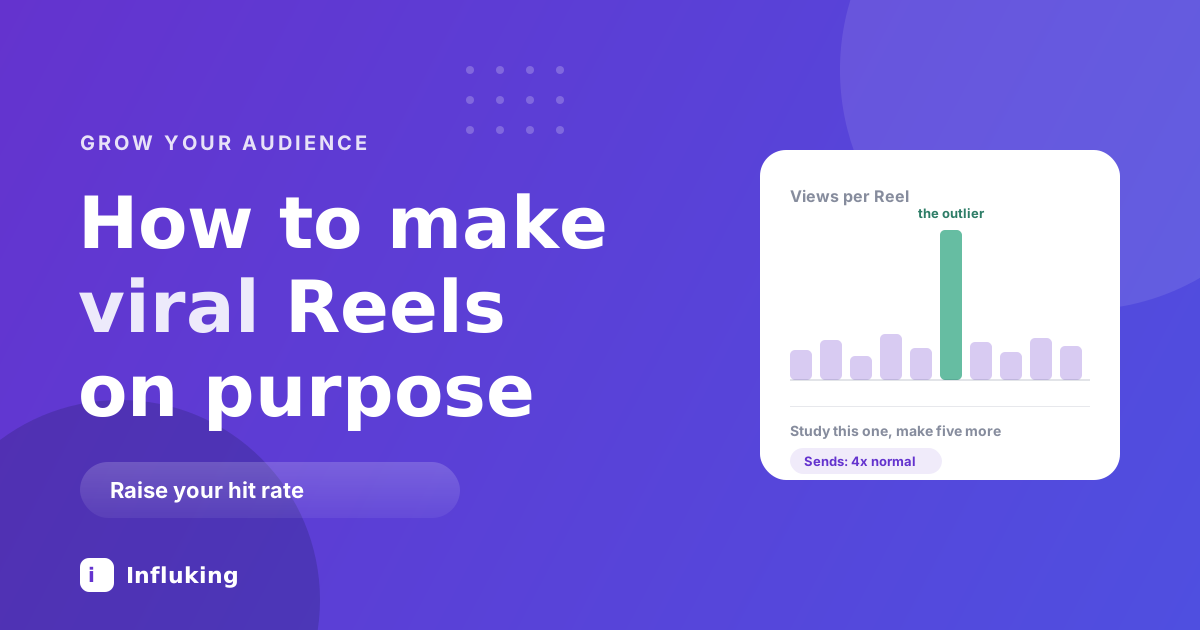
Reach on Reels follows a small number of posts doing most of the work. Look at any account's last fifty Reels and you will see a flat line with two or three spikes. The spikes pay for everything else.
So the goal is not to make a viral Reel. It is to post often enough, and well enough, that spikes happen more often. That reframing matters, because it stops you agonising over one post and starts you looking at patterns across twenty.
It also means volume alone will not save you. Ten weak Reels a week does not beat four considered ones, because the ceiling on a weak idea is low no matter how many you make.
The idea does most of the work
Editing gets the attention in these conversations, but the single biggest predictor of whether a Reel travels is what it is about. A brilliant edit of a boring idea stays boring.
Content that travels usually triggers one of these:
- Genuine usefulness. Solves a specific problem quickly, so people save it for later and send it to someone with that problem.
- Surprise. Shows something the viewer did not know was possible or true. The whole "wait, what" category.
- Recognition. Names an experience people have had but never articulated. This is why "POV" content works: people send it to the friend who does exactly that.
- Disagreement. A clear opinion that a reasonable person could argue with. Comments are reach, and mild controversy generates them.
- Craft. Something done so well that watching it is the point. Slow, satisfying, skilled.
Pick one. A Reel trying to be useful and funny and beautiful usually lands as none of them.
Steal formats, not content
Open the accounts in your niche and sort mentally for outliers: the post that did ten times what that account normally does. Ignore their averages, which tell you about their audience size rather than about the idea.
For each outlier, work out the format underneath it. Not "she showed a skincare routine" but "she showed the result first, then the three-step method, in under 20 seconds, with the price on screen". The format is the transferable part. Then make that format with your own content, your own opinion, your own footage.
Formats travel across niches too. A structure that works for a chef often works for a mechanic. Watching outliers outside your category is where genuinely fresh angles come from.
The first second
Nothing else matters if people scroll. Instagram cannot tell your Reel is good if nobody watches long enough to prove it.
Openings that hold:
- The end result. The finished thing, immediately, before any process.
- An open loop. A statement that demands the next sentence. "This cost me 40,000 rupees to learn."
- Motion. Something entering the frame or changing fast enough to register as movement in a scrolling feed.
- A face mid-sentence. Already talking, already animated. No settling-in.
Cut every greeting, every "so basically", every second of you walking toward the camera. Start on the second sentence you filmed. The mechanics of doing this well are in our Reel editing guide.
Match the text on screen to the spoken hook, because a large share of viewers have the sound off and need the same reason to stay.
Ask who sends this to whom
This is the most useful question in the whole process, and almost nobody asks it before filming.
Instagram weights sends heavily, because forwarding something into a private conversation is the strongest evidence that it was worth someone's time. So before you make a Reel, name the exact person a viewer would send it to. The friend who always overcooks pasta. The colleague who keeps mispronouncing that word. The partner who wants to redo the balcony.
If you cannot name that person, the Reel will probably plateau at your existing audience. If you can, you have found the thing to make explicit in the content.
Structure it to be watched twice
Rewatches count as watch time, and short Reels get rewatched much more easily than long ones. A 12 second Reel watched twice beats a 45 second Reel abandoned at 20.
Three ways to earn the second watch: end where you began, so the loop is seamless. Pack in more detail than one viewing catches. Or land the payoff so fast that people scroll back to check what they saw.
Whatever you do, get to the point quickly. Front-load the value and let context come later, if at all.
Design for the sound-off viewer
Assume no audio. That means captions, on-screen text carrying the key beats, and visuals that make sense muted. Then add sound as a bonus rather than a requirement.
Trending audio can help a Reel travel, but only when the cut respects the beat. A trending sound bolted onto a poorly timed edit does nothing. And if the audio choice would confuse the muted viewer, it is the wrong choice.
Read your outliers, then repeat them
After every batch of ten Reels, spend fifteen minutes on the numbers. Rank them by views, then look at the top two and ask what they share: the format, the topic, the hook type, the length.
Then check the numbers that predict travel rather than describe it:
- Sends per reach, the strongest single indicator that something has legs.
- Saves per reach, which tells you the content was useful enough to keep.
- Retention graph. A cliff at three seconds is a hook problem, a slow slide is pacing.
- Follows per Reel, because views without follows means the profile is not converting.
When a format works, make five more of it. Most creators do the opposite: something hits, and they move straight on to a new idea. Series are how a single good format turns into months of reach, and how people learn to follow you rather than just watch you. The full breakdown of what each surface rewards is in our post on how the Instagram algorithm works.
The day one takes off
A viral Reel is worth far more if you are ready for it, and most people are not.
- Reply to comments fast. The first few hours of engagement feed the distribution, and answering questions keeps the thread alive.
- Check your profile immediately. Thousands of strangers are about to look at it. Make sure the bio says what you do and the top row shows more of what they just watched.
- Post a follow-up within a day. The people who arrived need a second reason to stay. A sequel to the viral Reel converts far better than something unrelated.
- Pin it. New visitors should land on the thing that brought them.
- Do not change everything. One hit does not mean your niche was wrong. Chasing whatever went viral into a new topic is how accounts lose the audience they just gained.
Viral is not the same as valuable
A Reel can do 2 million views and bring you 200 followers and no money, usually because it reached people with no reason to care about the rest of your work. Broad, easy content travels furthest and converts worst.
A Reel that does 30,000 views inside your actual niche and brings 600 followers who want what you make is the better outcome every time. Brands buy that audience. They do not buy a spike. Our rate card guide covers how to price against real engagement, and Influking matches creators with brands by audience fit rather than follower count.
Mistakes that cap your reach
- Chasing every trend. By the time you have learned the dance, the trend has moved and your account looks like everyone else's.
- Long intros. The single most common reason a good idea gets 700 views.
- Making it for your followers. Reels are shown to strangers. Content that needs context does not travel.
- Judging after an hour. Reels get picked up days later now. Give it a week.
- Abandoning a working format. If it hit, do it again. Novelty is overrated.
- Buying views. Purchased views do not send, save or follow, so the signals stay flat and the account learns nothing. The same logic applies to bought followers.
Nobody makes a viral Reel on demand, including the people selling courses about it. What you can do is pick ideas that give people a reason to forward them, open fast enough to be seen, and study your own outliers instead of someone else's averages. Do that for six months and the spikes stop feeling like accidents.