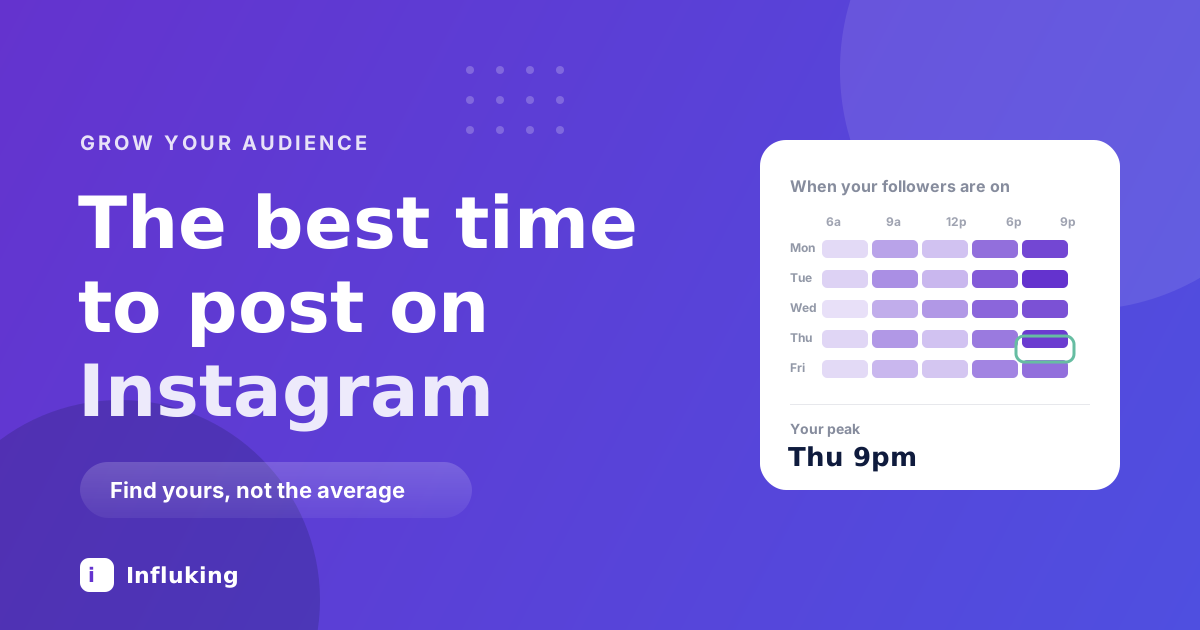
Search this question and you get a chart. Tuesday at 11am, Wednesday at 2pm, avoid Sundays. Those numbers come from averaging millions of accounts across every country, industry and audience, which makes them true of nobody in particular and useful to almost no one.
The honest version is more boring and much more useful. Posting time matters less than it did three years ago, it matters more for some things than others, and your own analytics already contain a better answer than any published chart.
Why timing lost most of its power
Instagram used to be close to chronological. Post when your followers were offline and your content scrolled past unseen before they opened the app. Timing was genuinely decisive.
Two changes broke that. Feed became ranked rather than chronological, so a good post from this morning can still sit near the top of someone's feed this evening. And Reels became a recommendation surface, where content gets shown to strangers over hours and days rather than minutes. A Reel can sit flat for four days and then travel, which is not a thing that could happen in a chronological feed.
So the window widened. Posting at a reasonable hour still helps you get an early signal from the people most likely to engage, and early engagement does feed the ranking. But the difference between a good hour and a mediocre one is small, and it is nowhere near the difference between a good hook and a weak one.
Where timing still genuinely matters
It has not stopped mattering everywhere. Four cases where it does:
- Stories. These are ranked mostly for people who already follow you and they expire in 24 hours, so being live when your audience is awake is the whole game.
- Small accounts. Under a few thousand followers, most of your reach comes from your own followers rather than recommendations, so their activity window is your window.
- Anything time-bound. A launch, a sale, a live session, a link that expires. Post these at peak activity because you need attention now, not eventually.
- Comment-driven content. If the post works by starting a conversation, you want to be around to reply while people are there, since replies keep a thread alive and interaction is a real signal.
Find your own window in ten minutes
Your account already knows this. Open Instagram, go to your professional dashboard, then Insights, then Total followers, and scroll to Most active times. You can toggle between hours and days.
Read it like this:
- Note the two or three peak hours. Ignore the single highest bar. You want the broad shape, not the winner.
- Post about an hour before a peak. That gives the post time to gather early engagement and be ranked well by the time the crowd arrives.
- Check the day view too. Most accounts have two or three strong days and a clear dead one.
- Check your audience location. If a large share of your followers are in a different country, the graph is already adjusted for their local behaviour but your intuition is not.
The data needs a reasonable follower base to be meaningful, so if you are under a thousand followers, use the general starting points below and revisit the graph later.
Starting points if you have no data yet
These are guesses to test, not answers. For an audience in India, three windows are worth trying first: the morning commute and first-coffee stretch of roughly 8 to 10am, the lunch break around 1 to 2pm, and the evening wind-down from about 8 to 11pm, which is when scrolling peaks for most consumer audiences.
Adjust for who you actually talk to. A B2B or professional audience is on during work hours and largely gone by Friday evening. Parents of small children are on late at night. Students are on late and all through the weekend. Shift workers break every pattern in every chart.
Weekdays tend to beat weekends for most niches, with Saturday usually the weakest day. Treat all of that as a hypothesis about your audience rather than a rule.
Test it properly, or do not bother
Most people test badly: they post at a new time twice, one post does poorly, and they conclude the time is wrong. Reach varies enormously between posts for reasons that have nothing to do with the clock, so a two-post sample tells you nothing.
A test that actually works:
- Pick two time slots you want to compare.
- Alternate between them for four weeks, keeping content type and quality as similar as you can.
- Record reach and follows for each post, along with the slot.
- Compare the medians, not the totals. One viral post will otherwise decide the whole experiment.
- If the difference is under about 20 percent, there is no difference. Pick the slot that suits your life and stop thinking about it.
That last line is the honest conclusion for most accounts. The gap between slots is usually small enough that consistency and convenience matter more than optimisation.
What beats timing, every time
If you have an hour to spend improving your reach, spend it here instead:
- The first second. A weak opening loses people before the algorithm learns anything about the post. Our Reel editing guide covers this in detail.
- Whether anyone would send it on. Sends and saves push distribution far harder than a well-chosen posting hour.
- Topic consistency. The recommendation system needs to know who to show you to, which is the practical argument for picking a niche.
- Posting at all, regularly. Four posts a week at an average time beats two posts a week at the perfect time.
The mechanics behind all of this are in our breakdown of how the Instagram algorithm works, which is worth reading before you spend any more energy on your posting schedule.
Scheduling without losing anything
Scheduled posts are not penalised. Instagram provides its own scheduling inside the app for professional accounts, and Meta Business Suite does it too, so the idea that scheduling tools suppress reach has never made much sense.
What scheduling does cost you is presence. If a post goes up while you are asleep, you miss the first hour of comments, and early replies are worth more than the exact minute of publication. Schedule for a time you can actually show up shortly afterwards.
Myths to ignore
- A single universal best time. Any article naming one hour for everyone is averaging away the only thing that matters, which is your audience.
- Posting on the hour or half hour. No mechanism exists for this. It is folklore.
- Deleting and reposting a slow post at a better time. You throw away the engagement it did collect and start from zero, and Reels often pick up days later anyway.
- Never post on weekends. True for some professional niches, false for entertainment, food, travel and most consumer content.
- Changing your posting time will fix flat growth. Flat growth is nearly always a content problem wearing a scheduling costume.
The practical answer
Look at Most active times in your Insights, pick a slot an hour before one of your peaks, post there consistently for a month, and check whether the median reach moved. If it did, keep it. If it did not, post when it suits you and put the saved energy into the hook.
Once your reach is steady, those posting patterns and engagement numbers become part of what you show brands. Our rate card guide covers how to price against real reach data, and Influking matches creators with brands running campaigns in their category.