Choosing a niche is where most creators and freelancers stall. Not because it is hard to think of one, but because committing to a niche feels like giving up every other option. What if you get bored? What if you pick wrong?
Here is the thing that changes the decision: a niche is not a cage, it is an entry point. It is the answer to "what do you do?" that lets a stranger decide in three seconds whether to follow you or hire you. Without it, the honest answer is "a bit of everything", and nobody knows what to do with that.
What a niche actually is
A niche is not a category. Fitness is a category. Fitness is also a hundred million accounts. "Strength training for women over 40" is a niche, because it names an audience and a problem at the same time.
The pattern that works is audience plus problem. Personal finance for freelancers with irregular income. Home cooking for people who hate washing up. Interior design for rented flats where you cannot drill the walls. Each of these tells someone immediately whether the content is for them, and that instant recognition is the whole point.
Notice that none of them are exotic. You do not need an original topic. You need a specific angle on a normal one.
Why picking one beats staying broad
Three things happen when you narrow down, and they compound.
Recommendation algorithms need a pattern to work with. Instagram, YouTube and TikTok all decide who to show your content to based on who engaged with your last few posts. If you post fitness on Monday, travel on Wednesday and finance on Friday, the audience signal contradicts itself and distribution suffers. Consistent topics give the system a clear group of people to keep serving.
Brands buy relevance, not reach. A skincare company would rather pay a creator with 6,000 followers who all care about acne than one with 60,000 general lifestyle followers, because the first audience converts. This is why a well-defined niche often means better rates at a smaller size.
And you get faster at making things. When your topic is fixed, ideas stop being a blank page. You already know the format, the audience and the recurring questions, so the work becomes execution rather than invention.
The three lists that find your niche
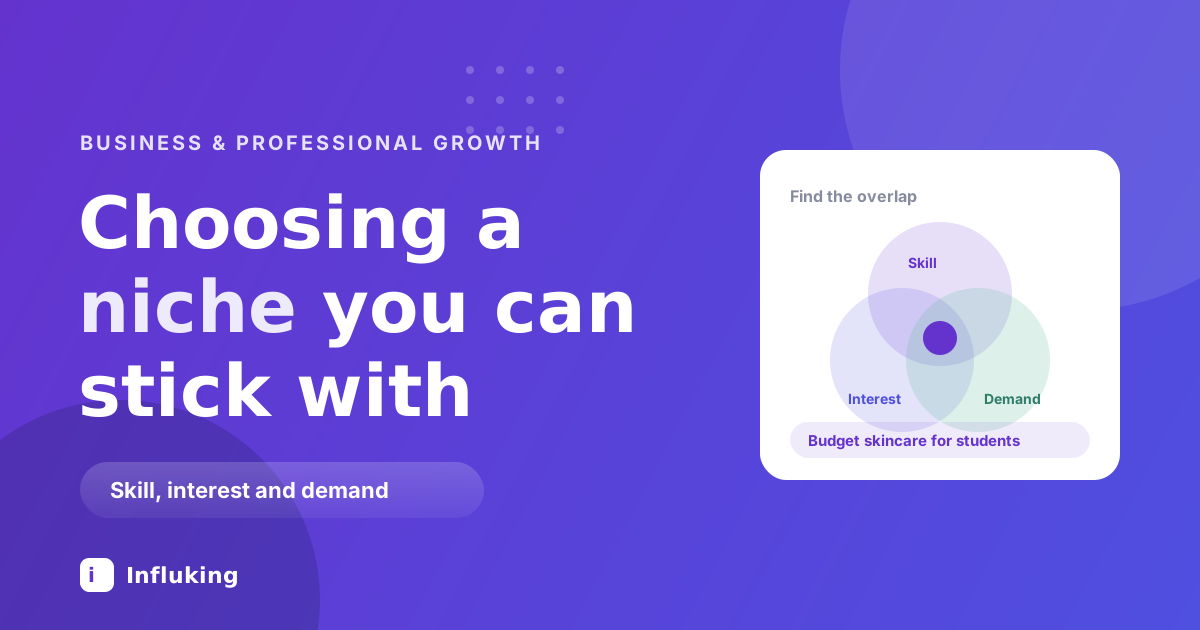
Skip the personality quizzes. Sit down with a page and write three columns.
- What you are good at. Skills, jobs you have done, things people say you make look easy. Include unglamorous ones. Being able to explain tax to a scared 25-year-old is a skill.
- What you would still find interesting in a year. This is the honesty column. Enthusiasm you have to manufacture runs out around month four, which is exactly when results start arriving.
- What people pay for. Products exist, brands advertise, courses sell, or clients hire. If nothing in the space costs money, there is no business behind the content.
Your niche lives where all three overlap. Two out of three is a common trap. Skill plus interest with no money is a hobby. Skill plus money with no interest is the version you abandon. Interest plus money without skill is where you get found out, though it can work if you are openly learning in public and say so.
Narrow enough, but not too narrow
The usual advice is to go as specific as possible. That is half right. There is a floor.
Ask two questions about your candidate niche. Could you list 50 pieces of content in it right now without straining? And are there at least a few thousand people who would care about all 50? If you cannot get to 50 ideas, you have picked a topic rather than a niche. If the audience is only a few hundred people, you have picked a hobby.
"Sourdough" is broad. "Sourdough for people in small flats without a stand mixer" is a niche with a clear person behind it. "Sourdough with one particular starter from one particular bakery" is a single post.
A useful compromise is to niche down for a year to get known, then widen gradually once people know why they follow you. Audiences will follow you into adjacent topics after you have earned their attention. They will not follow a stranger with no clear reason to exist.
Check the demand before you commit
Half an hour of research saves you six months on a topic nobody searches for.
- Search the niche on the platform you will use. Look at the top accounts. Are they growing, posting regularly, getting real comments? An empty space usually means no demand, not an untapped opportunity.
- Check the comments, not the likes. Comments tell you what people are confused about, and confusion is content. Screenshot the good ones and keep them.
- Look for money in the space. Are brands running ads to this audience? Do products exist at various prices? Are other creators visibly doing paid partnerships? That is your proof of a budget.
- Search the phrases people would type. Google autocomplete and the "people also ask" box show you exactly how your audience words their problems, which is also how you should title things.
- Count the competition honestly. Some competition is healthy. If ten accounts are thriving there, the audience exists. If a hundred huge accounts own it completely, narrow your angle.
Test it before you marry it
You cannot decide this on paper. Take your top two candidates and post for 30 days, roughly two weeks each, and watch what happens.
Three signals matter more than views. Whether you were willing to make the content on a bad day, because that predicts whether you will still be doing it in a year. Whether people saved or shared it, which says the content was useful rather than just watchable. And whether anyone sent you a question, since questions mean you are becoming a person they associate with the topic.
Thirty days is not enough to prove a niche works. It is enough to reveal which one you can stand.
Turning a niche into income
Once you are known for something specific, money tends to arrive through familiar doors: brand collaborations in your category, clients who want exactly your specialism, or your own product for the audience you built.
The niche is what makes those doors open at a small size. A brand looking for creators filters by category and audience fit long before it filters by follower count, so a clearly defined account gets shortlisted while a general one never surfaces. If you are heading in that direction, our guide to landing your first paid brand collaboration covers the pitch and the pricing, and Influking matches creators with brands running campaigns in their category.
Your niche also feeds directly into your personal brand, since the sentence people use to describe you is usually just your niche said out loud.
When it is right to change niche
Changing is normal. Changing every six weeks is the problem.
Good reasons to move: you have genuinely outgrown the topic, the audience keeps asking for something adjacent, or you have found a better paying angle on the same skill. Bad reason: three months in and growth is slower than you hoped. That is not a niche problem, that is the normal shape of the first three months.
When you do shift, move sideways rather than jumping. Budget skincare to skincare for sensitive skin keeps most of your audience. Budget skincare to crypto keeps none of it, and you start from zero with an account that now confuses everyone.
Mistakes people make choosing a niche
- Picking whatever is trending. If you do not care about it, the content will show it, and the trend will move before you get good.
- Refusing to choose. "I want to keep my options open" is the slowest option of all, because you never build a reason for anyone to follow you.
- Choosing purely for money. High-paying niches are only high-paying if you last long enough to get established in them.
- Copying a big account's niche exactly. They already own it. Find the version of it that only you can do, usually by adding your own audience or constraint.
- Waiting to feel qualified. Being two steps ahead of your audience is enough. Beginners often explain things better than experts do.
A niche is a starting point, not a life sentence
Write yours as one sentence: I make [content] for [audience] who want [outcome]. If a stranger could repeat it back after reading it once, it is specific enough. Then give it a year of consistent work before you judge it.
Most people who feel stuck at this stage are not missing the right niche. They are avoiding the discomfort of choosing one at all, and the choice matters far less than the year that follows it.