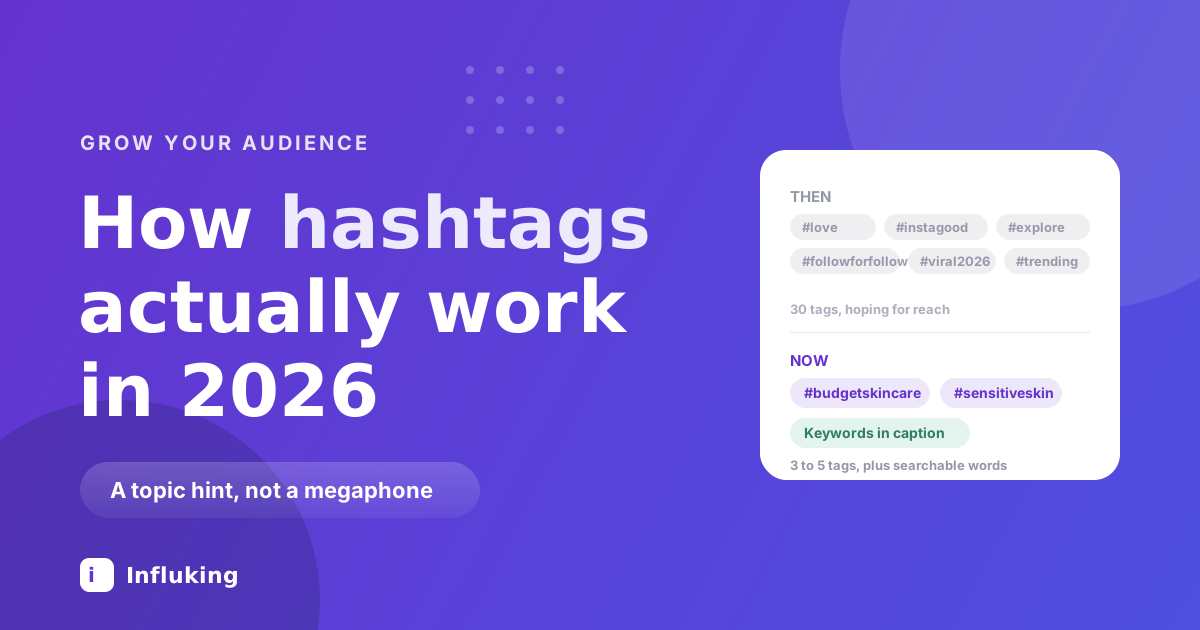
Somewhere between 2016 and now, hashtags went from the main way people found new accounts to a mild filing label, and a lot of advice never got the memo. You still see creators pasting thirty tags into a first comment, copying "best hashtags for 2026" lists, and wondering why the reach never arrives.
Here is the current state of it, what hashtags genuinely still do, and what took over the job they used to have.
The short version
Hashtags tell the platform what your post is about. That is nearly the whole function now. They help categorise content so recommendation systems have a hint about who might want it, and they let people find posts through search or through a tag page they deliberately visit.
What they no longer do is generate reach on their own. Adding more tags does not add more distribution, and the difference between a good set of five and a bad set of five is small. Instagram has said as much in various forms: hashtags are not a growth strategy, they are metadata.
What changed
Three things happened, and together they moved hashtags from the centre of discovery to the edge of it.
Recommendations took over. Reels and Explore now decide what to show people by predicting behaviour: will this person watch to the end, send it on, save it. Those predictions come from how the content performs with real viewers, not from the labels attached to it. A Reel with no hashtags that holds attention will out-reach a Reel with thirty that does not.
Search got smarter. Instagram indexes captions, on-screen text and profile fields now, so someone typing "best sunscreen for oily skin" can find your post whether or not you tagged it. The platform no longer needs a hashtag to work out the topic, which is exactly why the hashtag matters less.
Instagram removed the ability to follow hashtags. That feature was retired, and with it went the passive stream of tag-based reach into people's feeds. What remains is people actively visiting a tag page, which far fewer do.
What hashtags still do well
Not nothing. Four jobs they still perform:
- Topic signalling. A few accurate tags help the system place your content, which matters most on a new account where there is little history to learn from.
- Niche community tags. Small, specific tags that a real community actually browses, like a local running club tag or a craft technique. These have low volume and genuinely engaged people.
- Campaign and branded tags. If a brand is running a campaign, the tag is how entries get collected and how the results get counted. This is the one context where the tag is the mechanism, not a hope.
- Events and locations. People do browse tags for a festival, a conference or a city while it is happening.
How many to use
Three to five relevant tags. That is it.
Instagram's own guidance has pointed at a small number for a while, and the reason is simple: a long tag list dilutes the topic signal you are trying to send. If your post is about sourdough and you have tagged food, baking, cooking, recipes, foodie, homemade, kitchen, chef, yummy and instafood, you have told the system nothing except that your post is vaguely food-adjacent. Five specific tags say more than thirty generic ones.
Put them in the caption rather than the first comment. The first-comment trick was always about hiding them for aesthetic reasons, and it makes no difference to how they are read. If you want them out of the way, put them at the end of the caption after a line break.
Choosing tags that are worth using
- Describe the content, not the ambition. Tag what the post is actually about. #viral and #explorepage describe nothing and appear on a billion unrelated posts.
- Go specific over broad. #sourdoughforbeginners beats #food every time. Broad tags put you in a stream you cannot compete in, and they tell the system less.
- Mix the sizes. One or two tags with millions of posts for topic context, two or three with tens of thousands where a real community browses.
- Check the tag before you use it. Tap it and look at the top posts. If the content there is nothing like yours, or the page is full of spam, the tag is doing you no favours.
- Keep a few for your own community. A tag people use to share their version of your thing is worth more than any trending tag, because it belongs to you.
Skip the copy-paste blocks entirely. Reusing the same thirty tags on every post is the pattern spam accounts have, and it teaches the system nothing about which post is about what.
What replaced hashtags
Plain language. Instagram search works on the words in your caption and the words on screen, which means writing what your video is about in ordinary English does more than any tag set.
- Say the topic out loud and put it on screen. On-screen text is indexed and doubles as a hook for the sound-off viewers.
- Write a caption a person would search. "How to fix a shirt collar that keeps folding" is both a good caption and a query someone types.
- Put your topic in your name field. The name field is searchable, so "Priya | budget skincare" surfaces for skincare searches. Your handle alone does not.
- Fill in the alt text. A small signal, free to add, and it makes your content accessible.
This is the same shift that happened on Google years ago: the machine got good enough at reading content that the labels stopped being necessary. The rest of the mechanics are in our breakdown of how the Instagram algorithm works.
Other platforms, briefly
TikTok works much the same way, with search-driven discovery and captions that read as sentences rather than tag lists. YouTube barely uses hashtags at all, apart from the three that appear above a title, since titles and descriptions carry the weight. LinkedIn still gives tags a bit more life than Instagram does, though three relevant ones remains the sensible ceiling. X uses them mostly for live events and conversations rather than discovery.
The direction is the same everywhere: fewer tags, more searchable words.
Mistakes still worth avoiding
- Thirty tags on every post. No extra reach, and a signal that you are running a template rather than making something for a specific audience.
- Banned or spam-adjacent tags. Some tags get restricted because of the content posted under them, and using one can limit the post's eligibility for recommendation. If a tag page shows a warning or almost no recent posts, avoid it.
- Irrelevant trending tags. Tagging a trend your post has nothing to do with gets you views from people who bounce immediately, which is a worse signal than fewer views from the right people.
- Blaming hashtags for flat reach. If a post did not travel, look at the first second and the send rate before you rewrite the tag list.
- Following annual hashtag lists. A list of "top hashtags" is a list of the most saturated tags on the platform, which is the opposite of what you want.
What to do this week
Cut your tag count to five, make each one specific to the actual content, and move the effort into writing captions and on-screen text in words people would search. Then check your reach over the next month. Most accounts see no drop, which is the clearest evidence available that the thirty tags were never doing the work.
If your growth is stuck, the fix is almost always upstream of the tags: a hook that does not hold, a topic mix the system cannot place, or content nobody would send to a friend. Our guides on Reel editing and growing to 10,000 followers deal with those directly, and Influking matches creators with brands once the reach is there.